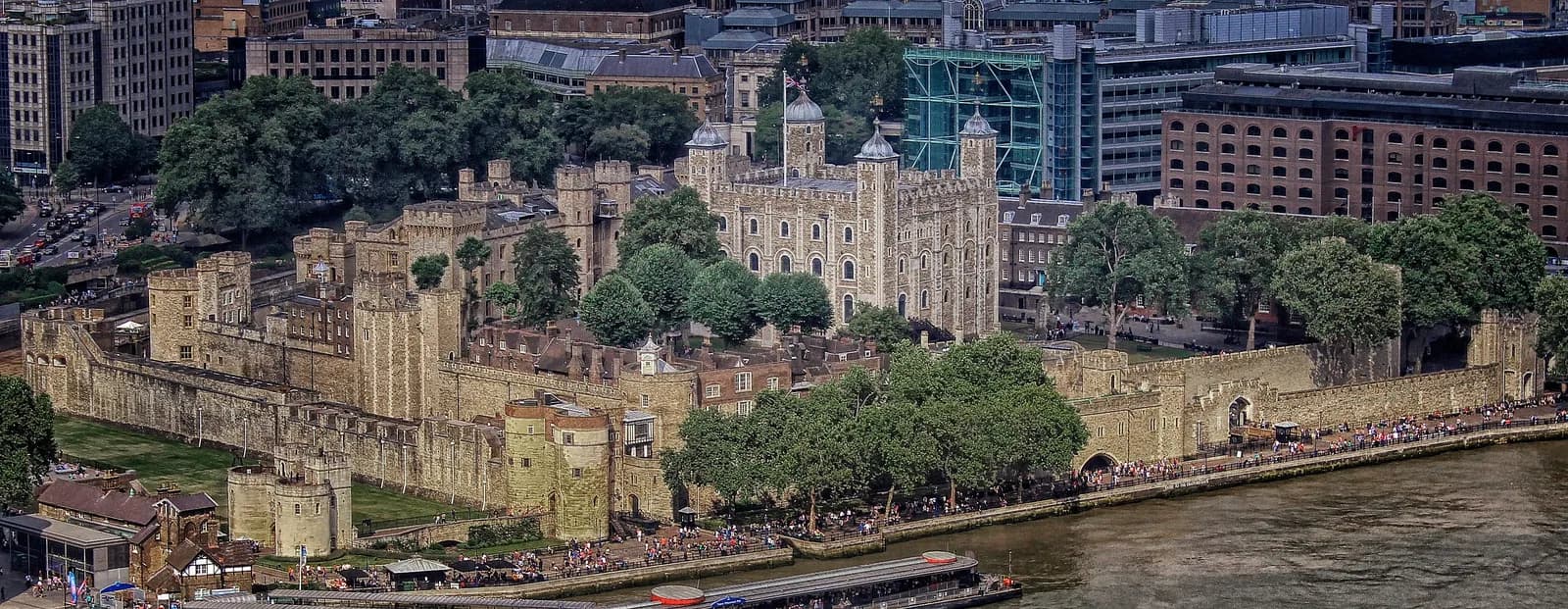
The Tower of London has dominated the north bank of the Thames for nearly a millennium, serving as royal palace, fortress, prison and treasury. Founded by William the Conqueror in 1066 and expanded over centuries, it remains one of London's most visited landmarks, drawing nearly three million visitors annually.
Norman Conquest and Construction
William the Conqueror ordered the construction of the White Tower in 1078, just twelve years after his victory at the Battle of Hastings. Measuring 36 by 32 metres at its base and rising 27 metres high, it was built from Kentish ragstone with Caen stone facing; a deliberate symbol of Norman power designed to dominate the skyline and remind Londoners of their new rulers. The Inner Ward took shape during the reign of Richard I (1189–1199), while Henry III added the east and north walls along with thirteen towers, of which only two have been completely rebuilt. Edward I completed the outer ward and concentric defensive layout by 1285, including the construction of St Thomas's Tower, later known as Traitors' Gate, where prisoners entered by boat from the Thames.
Royal Residence and State Functions
For centuries, the Tower served as a grand royal palace and the stage for coronation ceremonies. From the early 14th century until the reign of Charles II in the 17th century, monarchs traditionally prepared at the Tower before processing to Westminster Abbey for their coronation. Beyond its ceremonial role, the fortress housed the Royal Mint, the treasury, the public record office and, from at least the 1330s, the Royal Menagerie of exotic animals. The total enclosed area expanded to nearly twelve acres under Richard II, with an additional six acres comprising the Tower Liberties.
The Tower as Prison
The phrase "sent to the Tower" became synonymous with imprisonment during the 16th and 17th centuries, though only seven people were actually executed within the fortress walls before the 20th century. Ranulf Flambard became the first known prisoner in 1100; he later escaped the White Tower by climbing down a rope smuggled inside a wine casket. Among the most famous captives were Anne Boleyn, imprisoned in 1536 on charges of adultery and incest before her execution on Tower Green by a French swordsman; Thomas More, executed for treason in 1535; and Lady Jane Grey, the uncrowned "Nine Days' Queen" who was beheaded alongside her husband Guilford Dudley in 1554. Elizabeth I spent two months imprisoned in 1554 for her alleged involvement in Wyatt's Rebellion, an experience that would not prevent her eventual accession to the throne. Sir Walter Raleigh endured thirteen years in the Bloody Tower with his family, writing "The History of the World" and cultivating tobacco on Tower Green.
The Tower held its last state prisoner in May 1941, when Nazi deputy leader Rudolf Hess was detained there briefly after his flight to Scotland. The final prisoners of note were the Kray twins, held for a few days in 1952 for failing to report for national service.
The Crown Jewels
The Tower houses the Crown Jewels of the United Kingdom within the Jewel House on the ground floor of the Waterloo Block. The collection comprises approximately 140 objects containing some 23,578 gemstones, including the 530-carat Cullinan I, the largest clear-cut diamond in the world, set in the Sovereign's Sceptre with Cross. Most items date from the Restoration of Charles II between 1660 and 1661; the medieval and Tudor regalia had been sold or melted down during the Interregnum. Only four pieces predate the Restoration, the oldest being a 12th-century anointing spoon.
The Jewels faced their most dramatic threat in 1671, when Thomas Blood attempted to steal the crown, sceptre and orb. Blood flattened the crown with a mallet and hid it under his cloak before being apprehended; remarkably, Charles II pardoned him. During the Second World War, the gemstones were removed from their settings, wrapped in cotton wool, and hidden in a biscuit tin buried beneath a basement at Windsor Castle. Today, the Crown Jewels are viewed by approximately 2.8 million people each year.
The Yeoman Warders
The Yeoman Warders, colloquially known as Beefeaters, have guarded the Tower since 1485, when Henry VII established the corps following his victory at the Battle of Bosworth. They represent the United Kingdom's oldest existing military corps and the oldest royal bodyguard still in operation. The nickname "Beefeater" first appeared in 1669, when Cosimo III de' Medici recorded that they received "a very large ration of beef" at court.
To serve as a Yeoman Warder, candidates must be retired from the British Armed Forces at the rank of Warrant Officer Class 1 or 2, with a minimum of 22 years' service and the Long Service and Good Conduct Medal. Thirty-two Yeoman Warders currently serve, led by a Chief Warder. They reside in tied accommodation within the Tower, conduct guided tours, and participate in the nightly Ceremony of the Keys, a tradition that has continued for over 700 years. Their ceremonial Tudor State Dress, worn for royal visits and special occasions, features the red and gold livery associated with the Yeomen of the Guard.
The Ravens of Legend
Eight ravens currently inhabit the Tower: Henry, Poe, Harris, Poppy, Georgie, Edgar, Chaos and Jubilee. According to legend, "if the Tower of London ravens are lost or fly away, the Crown will fall and Britain with it." This tradition is linked to Welsh mythology surrounding Brân the Blessed, whose head was supposedly buried beneath the White Hill upon which the Tower stands. The earliest known depiction of ravens at the Tower dates from 1883, though official Tower historian Geoffrey Parnell has noted that the mythology is "likely a Victorian flight of fantasy," with the first written reference appearing only in 1918.
The ravens are cared for by the Ravenmaster, a Yeoman Warder appointed to the role. Their flight feathers are clipped on one wing to prevent long-distance flight, and they receive a diet of raw meat, lambs' hearts, blood-soaked biscuits and boiled eggs with shell. The Ravenmaster checks their health weekly and trims their feathers every three weeks. The ravens are officially "enlisted as soldiers" with attestation cards, and can be dismissed for misconduct; Raven George was discharged in 1986 for attacking television aerials.
During the Blitz of the Second World War, only three ravens survived the bombing. Winston Churchill ordered the flock rebuilt to maintain the required six birds, a number that has since increased to eight.
World Heritage and Modern Visitors
The Tower of London was designated a UNESCO World Heritage Site in 1988, recognised as "the most complete 11th-century fortress palace remaining in Europe" and a symbol of Norman power. It is cared for by the charity Historic Royal Palaces under the ceremonial charge of the Constable of the Tower. In 2025, the Tower welcomed 2,817,852 visitors, making it the ninth most popular tourist attraction in the United Kingdom.
The fortress remains open daily throughout the year, except on 24 to 26 December and 1 January. Admission includes access to the Crown Jewels, the White Tower, the raven enclosures and free guided tours conducted by the Yeoman Warders. King Charles III holds the Tower in right of the Crown, continuing a tradition of royal ownership that spans nearly a thousand years.